

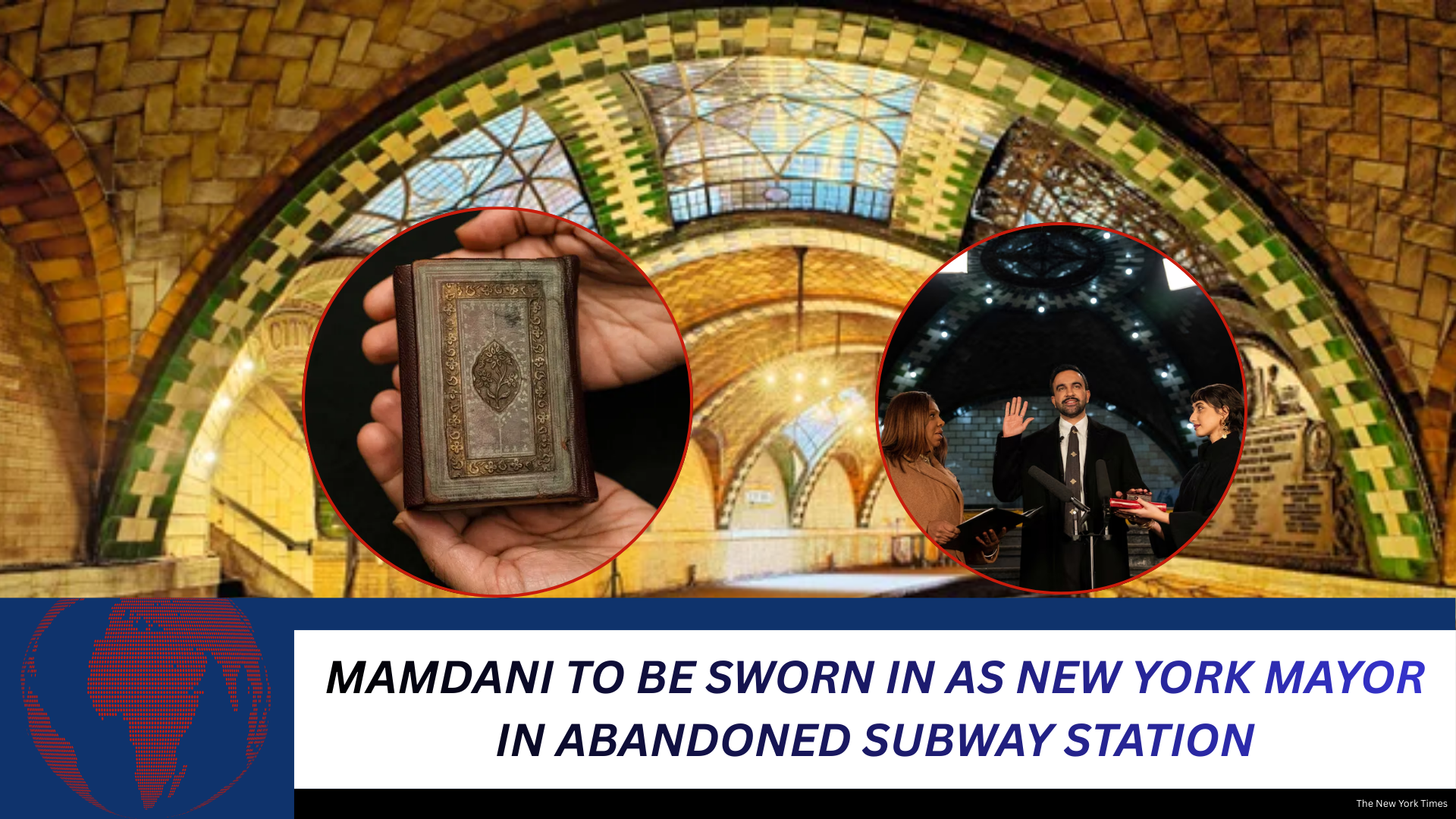


Zohran Mamdani was officially sworn in as the new mayor of New York City in a setting unlike any used before by a city leader: an abandoned subway station beneath the streets of Manhattan. The unconventional ceremony immediately captured public attention, signaling that Mamdani intends to govern differently from his predecessors and challenge long-standing political traditions.
The swearing-in took place at the long-closed Old City Hall subway station, a historic yet largely forgotten space that once served as a bustling transit hub. The station, known for its elegant arches, tiled ceilings, and curved platforms, has been closed to the public for decades. By choosing this location, Mamdani aimed to highlight both the city’s rich history and the need to revive overlooked spaces and communities.
Supporters gathered underground alongside city officials, union leaders, community activists, and family members. The atmosphere blended ceremony with symbolism. Instead of the grandeur of City Hall or a public plaza, the muted lighting and echoing tunnels created a powerful visual reminder of the city’s layers—past, present, and future converging in a single moment.
In his inaugural remarks, Mamdani spoke about accessibility, equity, and rebuilding trust between government and residents. He emphasized that New York’s strength lies not only in its skyline but also in its infrastructure, workers, and neighborhoods that often remain unseen. The abandoned subway station, he said, represented both neglect and possibility—an apt metaphor for the challenges facing the city.
Mamdani’s rise to the mayoralty has already been described as historic. Known for his progressive views and grassroots campaign style, he built momentum by focusing on housing affordability, public transportation, labor rights, and climate resilience. His decision to hold the swearing-in underground reinforced his image as a leader focused on everyday New Yorkers rather than political pageantry.
The choice of venue also sparked conversation across the city. Some praised the move as creative and meaningful, applauding Mamdani for breaking with tradition and using the moment to send a message about renewal and inclusion. Others questioned whether the ceremony was unnecessarily theatrical. Still, even critics acknowledged that the event succeeded in drawing attention to his priorities and setting the tone for his administration.
Security was carefully coordinated to ensure safety in the aging station, which is typically accessible only through guided tours. City engineers and transit officials worked behind the scenes to prepare the space, installing temporary lighting and ensuring structural stability. Despite the logistical challenges, the ceremony proceeded smoothly, reinforcing the mayor’s message that innovation and cooperation can overcome obstacles.
Historically, mayoral inaugurations in New York have been held in prominent civic locations meant to reflect power and authority. Mamdani’s decision to step away from that tradition underscores a shift in how leadership is being defined. Rather than focusing on hierarchy, his approach centers on visibility for spaces and people often overlooked by those in power.
Transportation advocates also welcomed the symbolic gesture. Mamdani has long supported expanded investment in public transit, emphasizing that reliable and affordable transportation is essential to economic opportunity and environmental sustainability. Holding the ceremony in a subway station underscored his commitment to revitalizing transit infrastructure and addressing long-standing issues within the system.
As he begins his term, Mamdani faces a city grappling with complex challenges. Rising housing costs, public safety concerns, aging infrastructure, and climate-related risks demand swift and effective action. His supporters believe his unconventional style and policy-driven approach position him well to address these issues. His critics, meanwhile, are watching closely to see whether symbolism will translate into results.
In his speech, Mamdani acknowledged the weight of responsibility that comes with leading one of the world’s most influential cities. He pledged to work collaboratively with city council members, state leaders, and community organizations to deliver tangible improvements. He also emphasized transparency and accountability, promising regular communication with residents about policy decisions and progress.
The ceremony concluded with applause echoing through the station’s tunnels, a moment that many attendees described as both surreal and inspiring. As the crowd made its way back to the surface, the message of the event lingered: a new administration beginning not above the city, but beneath it—rooted in history, infrastructure, and the lived experiences of its people.
Zohran Mamdani’s underground swearing-in will likely be remembered as one of the most unconventional inaugurations in New York City history. Whether it becomes a defining symbol of his leadership will depend on what follows. For now, the event has unmistakably set the tone for a mayor determined to challenge norms, spotlight overlooked spaces, and redefine how leadership connects with the city it serves.