

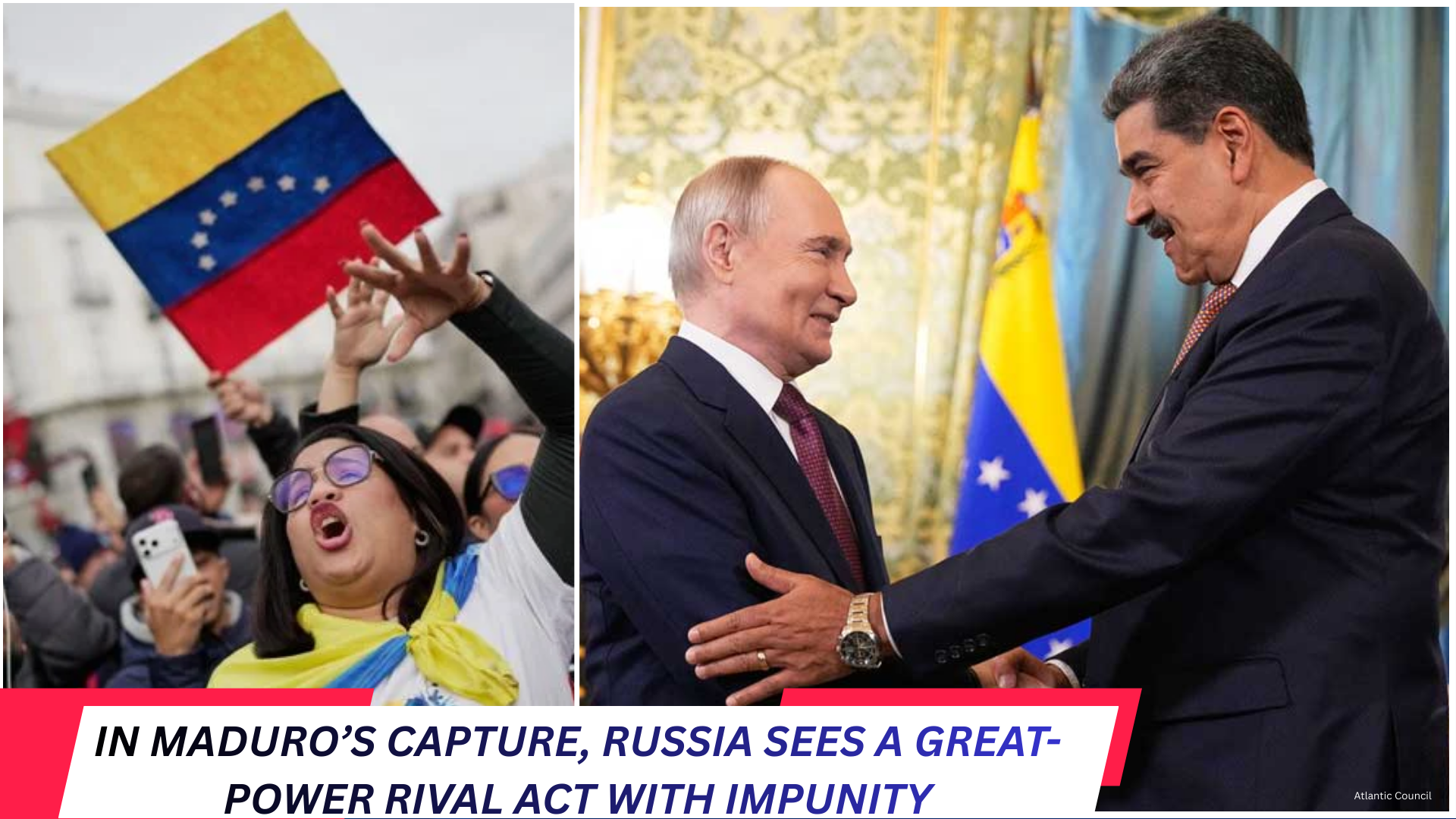


The capture of Venezuelan leader Nicolás Maduro by U.S. forces has sent ripples far beyond the Western Hemisphere. In Moscow, the episode is being read less as a regional intervention and more as a blunt demonstration of how a rival great power can act decisively, unilaterally, and without immediate consequence. For Russian officials and analysts, the event reinforces a longstanding view of the international system: power, not principle, ultimately determines outcomes.
Russia’s official response has been restrained but firm. The Foreign Ministry condemned the U.S. operation as a violation of Venezuela’s sovereignty and an act of armed aggression. Statements emphasized respect for territorial integrity and warned that the use of force against a sitting head of state undermines international law. The language was familiar, echoing Moscow’s frequent appeals to the United Nations Charter and the norm of non-interference.
Yet beneath the formal condemnation lies a more complex reaction. Russian commentators close to the government have framed the operation as proof that the United States retains the ability to impose its will abroad with speed and precision. From this perspective, the Maduro capture is not simply about Venezuela. It is about hierarchy in the global system — who can act, and who must react.
For years, Russia has argued that the so-called rules-based international order is applied selectively. The U.S. action in Caracas, carried out without broad international authorization and followed by limited immediate repercussions, appears to confirm that belief. In Moscow’s reading, Washington acted first and justified later, confident that diplomatic criticism would not translate into material costs.
The loss of Maduro also carries concrete strategic implications for Russia. Venezuela had been one of Moscow’s most reliable partners in Latin America. The relationship offered symbolic value, limited military cooperation, and a foothold in a region long dominated by U.S. influence. Maduro’s removal underscores how fragile such partnerships can be when confronted by overwhelming force. It also highlights the limits of Russia’s ability to protect distant allies.
This contrast is not lost on Russian observers. The speed and clarity of the U.S. operation stand in sharp relief against Russia’s own military and diplomatic challenges elsewhere, particularly in Ukraine. While Moscow has invested significant resources over years with mixed results, Washington demonstrated an ability to act swiftly and decisively in its near-abroad. That comparison has fueled quiet unease among Russian strategists.
At the same time, there is an element of realism in Moscow’s response. Some analysts suggest that the U.S. intervention, while damaging to Russian interests in Venezuela, may also distract Washington. If the United States becomes responsible for stabilizing Venezuela’s political and economic future, it may divert attention and resources from other theaters that matter more to Russia. This is not an endorsement of the action, but a calculation rooted in balance-of-power thinking.
The episode also reinforces Russia’s broader worldview about great-power behavior. In this view, international law serves as a language of convenience rather than a binding constraint. Powerful states invoke it when useful and sidestep it when necessary. The United States’ willingness to remove a foreign leader by force, despite predictable criticism, strengthens Moscow’s argument that spheres of influence remain the true organizing principle of global politics.
This perspective helps explain why Russia’s criticism, while sharp, has been measured. There has been no rush toward escalation or concrete retaliation. Instead, Moscow has focused on diplomatic forums, statements of principle, and rhetorical alignment with other critics of the operation. The goal appears less about reversing the outcome in Venezuela and more about shaping the narrative around legitimacy and precedent.
That narrative has domestic importance as well. Russian leaders have long justified their own actions abroad by pointing to Western interventions. The Maduro episode provides fresh material for that argument. It allows Moscow to claim that Washington practices the very unilateralism it condemns elsewhere, reinforcing domestic support for Russia’s skeptical view of Western intentions.
Still, the situation exposes a degree of vulnerability. Russia could not prevent the removal of an allied leader, nor could it meaningfully influence events as they unfolded. For a country that seeks recognition as a global power, that limitation is significant. It underscores the gap between aspiration and capability, particularly outside Russia’s immediate neighborhood.
In the end, Russia’s reaction to Maduro’s capture is less about outrage than recognition. It reflects an acceptance — uneasy but pragmatic — that the current international system still rewards decisive power. For Moscow, the lesson is not that rules no longer matter, but that they matter unevenly. Great powers, in this view, continue to set the terms.
The broader consequence may be a deepening of cynicism about international norms. If the perception takes hold that forceful action carries few costs, it risks encouraging similar calculations elsewhere. Russia has warned of this danger before, even as it navigates the same realities. The Maduro episode adds another chapter to that unresolved tension between law and power.