

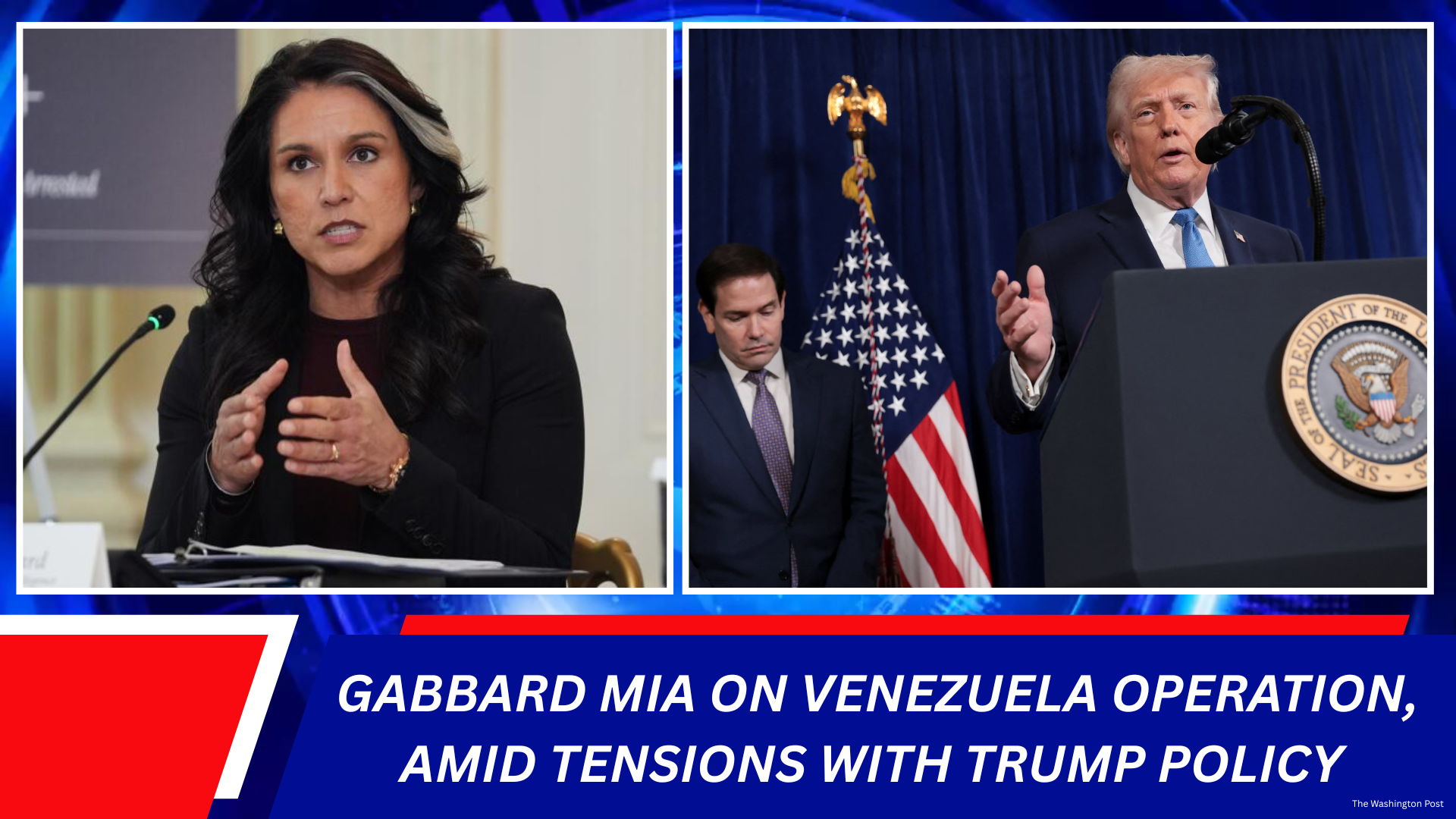


The recent U.S. military operation in Venezuela, which resulted in the capture of President Nicolás Maduro, has reignited debates over American foreign policy, executive decision-making, and the role of dissenting voices within government. One of the most striking aspects of the operation was the absence of Tulsi Gabbard, the director of national intelligence, from both planning discussions and public commentary immediately following the raid. This silence stands in sharp contrast to the rapid, coordinated messaging typically expected from senior national security officials and underscores ongoing tensions between Gabbard’s non-interventionist philosophy and the Trump administration’s more aggressive approach to foreign affairs.
Gabbard’s career has long been defined by her skepticism of U.S. military interventions abroad. During her time as a congresswoman and later as a presidential candidate, she consistently warned against entangling the United States in conflicts she deemed unnecessary or counterproductive, particularly in the Middle East and Latin America. Her approach to foreign policy has emphasized diplomacy, multilateral engagement, and caution in the use of military force. The Maduro operation, which involved covert planning, targeted strikes, and high-level coordination across multiple branches of government, ran counter to many of the principles Gabbard has championed.
Despite her prominent position overseeing U.S. intelligence operations, Gabbard was reportedly not involved in the day-to-day planning of the Venezuela mission. Senior administration officials described her role as largely observational, receiving updates after major decisions had been made. This marginalization appears to have been influenced both by ideological differences and by a broader tension between traditional national security leadership and the Trump administration’s preference for a tightly controlled decision-making circle that favored officials aligned with interventionist or aggressive policy goals.
The gap between Gabbard’s philosophy and the administration’s approach became even more evident in her public commentary. Unlike other officials who issued statements or participated in briefings immediately following the operation, Gabbard remained largely silent for several days. When she did address the mission, her statements were brief, neutral, and largely symbolic, avoiding detailed praise or critique. This measured response underscores her careful balancing act: acknowledging a successful operation conducted by her government while maintaining the principles of non-intervention that have long defined her foreign policy outlook.
Observers have noted that Gabbard’s absence from the operational spotlight raises broader questions about the role of dissenting voices in shaping national security decisions. In an administration that often centralized decision-making among a small cohort of loyal advisors, the lack of substantive involvement from officials with alternative perspectives can limit debate and reduce the quality of strategic assessments. Gabbard’s expertise in intelligence and her experience with foreign conflicts might have provided valuable counterpoints during planning, particularly regarding potential unintended consequences or regional diplomatic fallout. The decision to sideline her voice highlights a persistent tension in governance: the balance between ideological cohesion and the inclusion of diverse perspectives in complex, high-stakes operations.
The situation also has implications for public perception and media coverage. Gabbard’s silence was widely noted by commentators, political analysts, and journalists, who highlighted it as indicative of the administration’s broader approach to messaging and control. In contrast to the highly orchestrated coverage surrounding the operation — which often featured select advisors and media figures in supportive roles — Gabbard’s muted response presented a subtle counter-narrative: even within the government, not all officials fully endorsed the use of military force in this instance. This divergence serves as a reminder that high-profile operations are often viewed differently by stakeholders within government, each with their own priorities, principles, and risk assessments.
The operation’s outcomes, both immediate and long-term, further accentuate the significance of Gabbard’s position. While the mission achieved its tactical objective, it also carries diplomatic, humanitarian, and strategic consequences. The capture of Maduro has reshaped power dynamics in Venezuela, drawn international attention, and raised questions about U.S. influence in Latin America. In such circumstances, the presence of dissenting voices like Gabbard’s can help ensure that policymakers consider a broad spectrum of scenarios, risks, and ethical implications, particularly when military actions intersect with international law and regional stability.
Gabbard’s approach in this instance reflects a cautious, principle-driven stance. By choosing to remain publicly neutral and minimally involved in operational planning, she reinforces the notion that high-level officials can maintain integrity and consistency in their policy positions, even amid internal pressure to conform. At the same time, her marginalization underscores the challenges faced by those advocating for restraint within administrations that favor assertive or interventionist policies.
Looking forward, Gabbard’s response to the Venezuela operation may shape future discussions about the role of non-interventionist perspectives in U.S. foreign policy. As the administration evaluates the outcomes of the mission and its impact on regional geopolitics, the tension between ideological restraint and operational decisiveness is likely to remain a critical factor in national security decision-making. Her presence, albeit quiet, serves as a reminder that the diversity of thought within leadership teams can influence both policy formulation and public trust.
In sum, Tulsi Gabbard’s absence and muted commentary on the Venezuela operation illuminate the friction between non-interventionist principles and assertive policy execution. Her careful balancing act reflects a commitment to long-held foreign policy beliefs while navigating the realities of executive decision-making under an administration with contrasting priorities. The episode underscores the broader importance of maintaining avenues for dissenting perspectives within government, particularly when military action carries complex, high-stakes consequences for both domestic and international audiences.