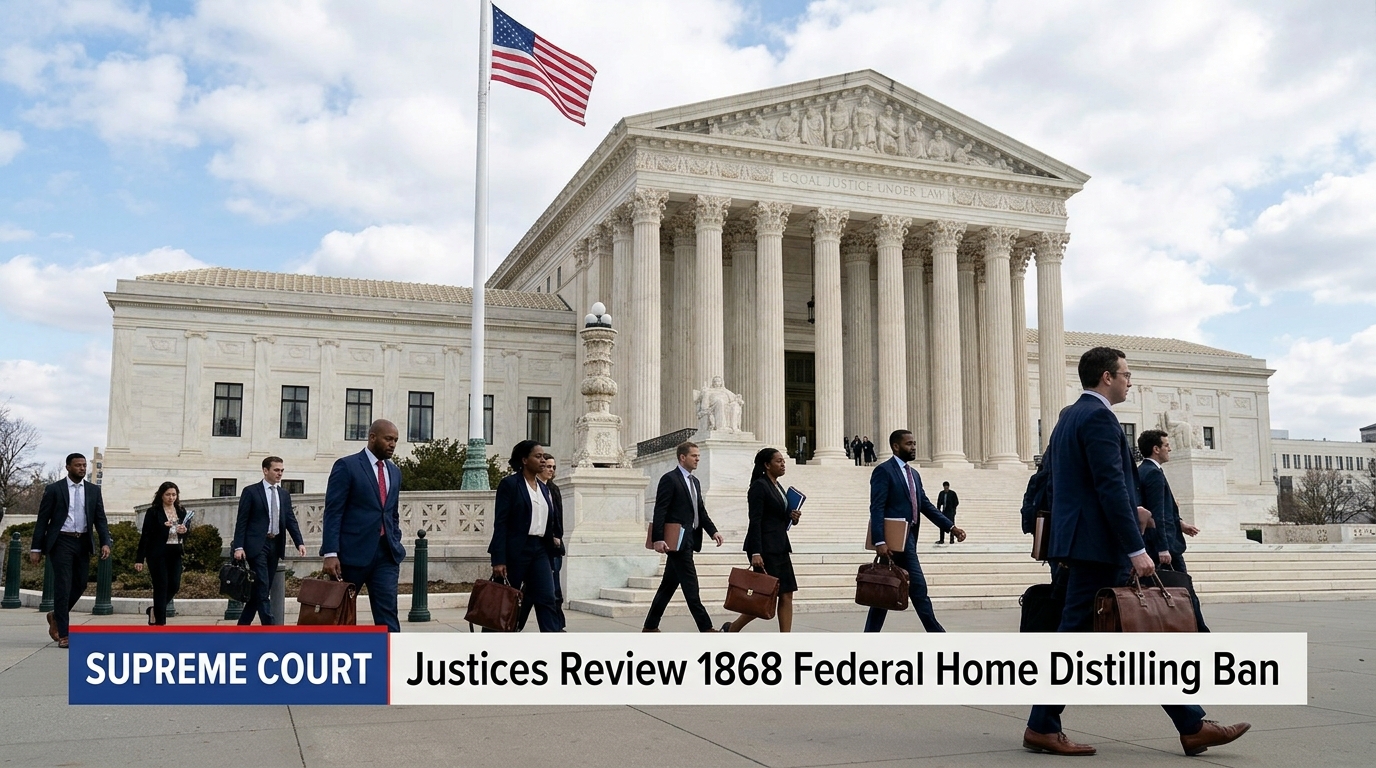


The U.S. Supreme Court has agreed to consider whether the federal government can constitutionally prohibit people from distilling alcoholic spirits in their own homes. The dispute centers on a law enacted in 1868, during the Reconstruction era, when Congress sought to combat tax evasion in the liquor industry.
The case, Department of Justice v. McNutt, is about more than the rules governing a home workshop. It asks how far Congress can go when using its constitutional power to collect taxes and pass laws considered necessary to carry out that authority.
A law rooted in post-Civil War tax enforcement
Federal authorities have long regulated the production of distilled spirits in part because alcohol taxes have historically been a source of government revenue. The challenged law prohibits producing distilled spirits in a dwelling house or certain structures connected to a home.
The government argues that restricting where distilling can occur helps prevent people from concealing production and evading federal taxes. Officials contend that home operations can be more difficult to inspect, making location restrictions a legitimate way to support tax enforcement.
The challengers argue that the government has exceeded its authority by making home distilling a federal crime even where the activity is intended for personal use. They contend that Congress cannot prohibit private conduct merely because it might make tax enforcement more difficult.
Conflicting court decisions bring the issue to the justices
Lower federal courts have reached different conclusions about the law. The Fifth Circuit ruled in favor of challengers who argued that the prohibition exceeded Congress's taxing power, while the Sixth Circuit upheld the federal restriction in a separate case.
That disagreement gave the Supreme Court an opportunity to clarify the legal standard. The justices' decision to hear the case does not mean they have already ruled the law unconstitutional or approved home distilling.
What the ruling could mean
The case could help define the relationship between federal tax authority and private conduct. A broad ruling for the government could reinforce congressional power to restrict activities that create significant enforcement difficulties. A ruling for the challengers could establish limits on how far that reasoning can extend.
The dispute also raises questions about federalism and the boundaries between national authority and individual freedom. Any decision would need to account for the history of alcohol taxation, the text of the statute and existing constitutional precedent.
Arguments are expected in a future court session, with a decision anticipated by the end of the Supreme Court's term. Until the Court issues a final ruling and any required legal changes take effect, the existing federal restrictions should not be treated as having been repealed.