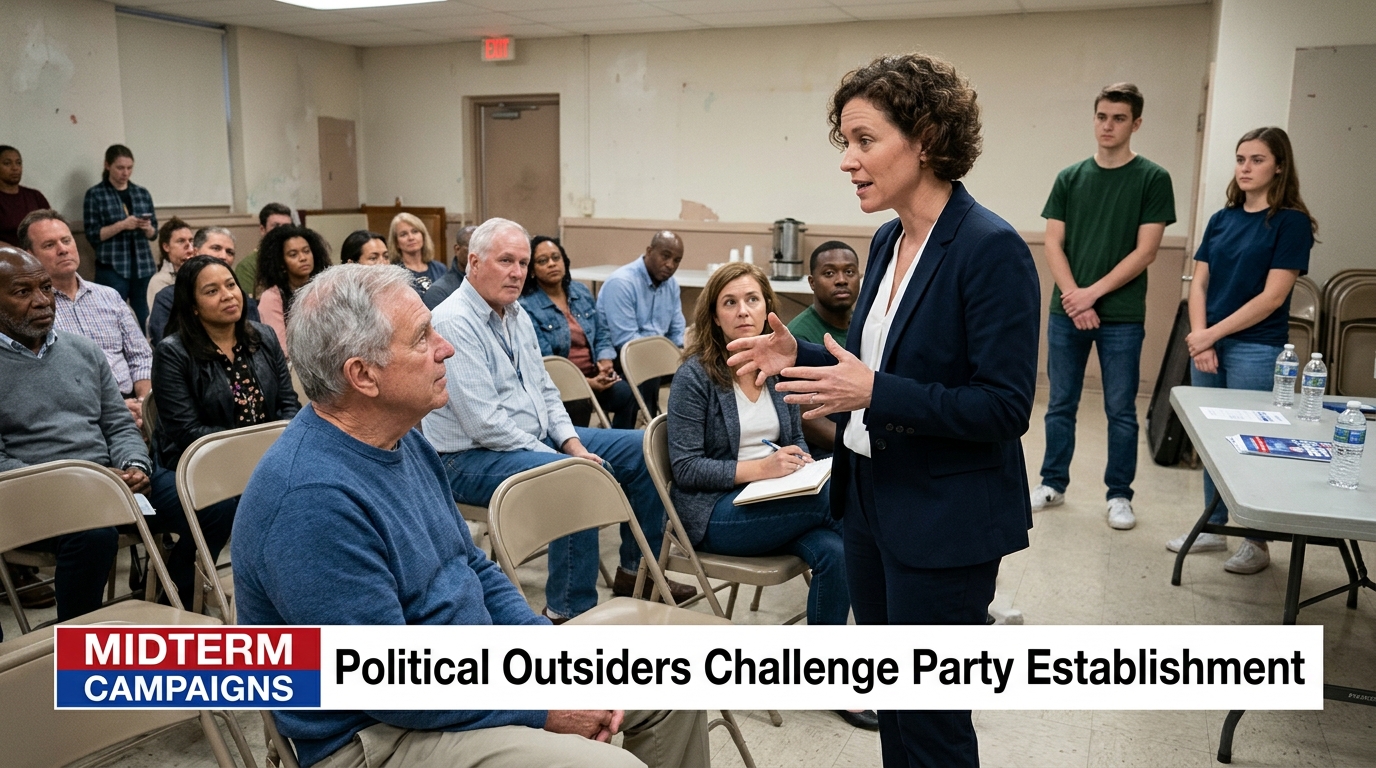


Candidates who distance themselves from traditional party politics are gaining attention in the 2026 midterm campaign, as contenders in both Republican-leaning and Democratic-leaning states try to connect with voters who are frustrated with Washington. Some emphasize backgrounds outside conventional politics, while others criticize their own parties and present themselves as independent-minded alternatives to established leadership.
The trend reflects a campaign environment in which party labels can be both valuable and burdensome. Party support provides access to fundraising networks, campaign infrastructure and committed voters. At the same time, national party leaders may be unpopular in some districts, prompting candidates to emphasize local identity and personal experience instead.
Different backgrounds, similar political message
Several candidates are using nontraditional backgrounds to distinguish themselves from career politicians. Examples include religious leaders, former athletes, veterans and candidates with experience in local communities rather than long careers in federal office.
Their messages differ by state and constituency, but many focus on frustration with political gridlock, distrust of established institutions and a desire for more direct representation. Some candidates continue to identify with a major party while distancing themselves from its national leadership. Others are running as independents or emphasizing that they do not follow party instructions automatically.
The strategy is not limited to one ideological camp. Candidates on the left and right may both argue that their party has failed to address the concerns of ordinary voters, although their proposed solutions can be sharply different.
An advantage that carries risks
A candidate who breaks with party orthodoxy may attract voters who are tired of familiar political arguments. However, distancing oneself from a party can also create practical difficulties. Campaigns still need volunteers, money, ballot access, data and a reliable organization capable of reaching voters.
Candidates who criticize their own party must also explain how they would work with colleagues if elected. A promise to be independent may be appealing on the campaign trail, but governing often requires coalitions, negotiations and votes on legislation.
There is also a risk that a candidate's message becomes unclear if criticism of the establishment is not accompanied by detailed policy proposals. Voters may welcome a fresh style while still wanting to know what the candidate would do about healthcare, taxes, education, public safety or federal spending.
What the trend says about the electorate
The rise of these candidates suggests that political dissatisfaction can create opportunities for figures who offer a different public image. It does not guarantee electoral success, and a candidate's personal appeal may not overcome a strong opponent or unfavorable district conditions.
The election will provide a clearer measure of whether anti-establishment messaging can translate into votes. Whatever the outcome, the trend offers a reminder that political parties must continually persuade voters that their labels and platforms still represent the people they hope to serve.