

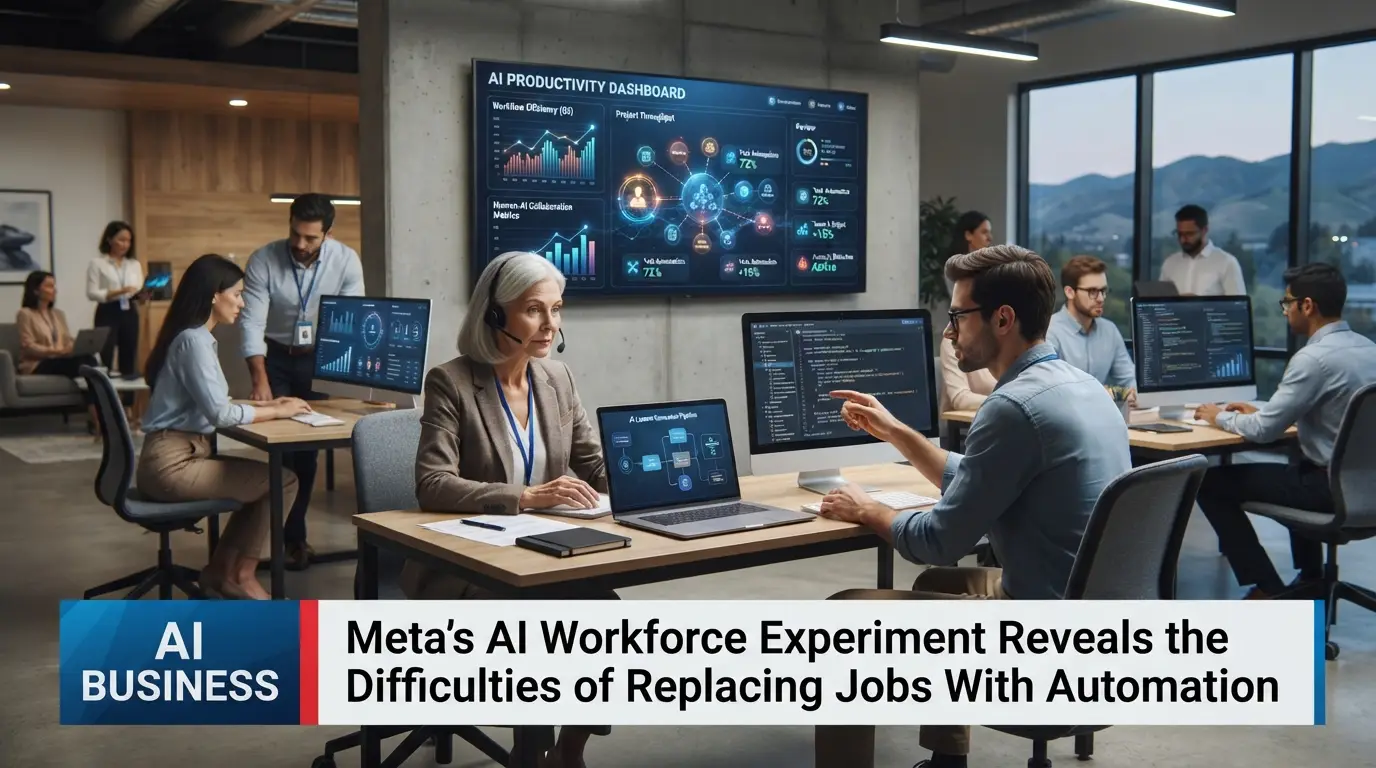


MENLO PARK, CALIFORNIA — Meta's attempt to reorganize parts of its workforce around artificial intelligence has exposed some of the difficulties large companies face when they move too aggressively toward AI-driven operations.
The company launched an internal initiative aimed at restructuring teams around AI agents, with plans that could have reduced some team sizes dramatically. Meta later pulled back from part of the strategy after internal concerns about productivity and employee disruption.
AI Transformation Is Not Simply a Software Upgrade
The episode offers an important lesson for corporate America.
AI can automate certain tasks, but replacing human workers requires more than deploying a powerful model.
Companies need to determine whether the technology actually performs reliably enough for important business functions.
Meta reportedly encountered internal problems as it attempted to accelerate the transition.
Employee concerns also became significant.
Workers worried that aggressive automation could make their jobs obsolete before AI systems were ready to perform those responsibilities consistently.
The company subsequently shifted toward a message emphasizing that AI should help employees rather than simply replace them.
That change reflects a broader issue facing U.S. businesses.
Executives are under pressure from investors to improve productivity through automation.
At the same time, employees are demanding clarity about how AI will affect their careers.
The economic consequences could be substantial.
If AI eventually performs large numbers of administrative, analytical and creative tasks, companies could reduce labor costs.
But premature automation can create new expenses if employees have to repair AI-generated mistakes.
Meta's experience therefore provides a case study for other American corporations.
The most successful AI transformations may ultimately involve a combination of automation and human oversight.
For investors, the question is becoming whether companies can achieve productivity gains without damaging their organizational capabilities.