

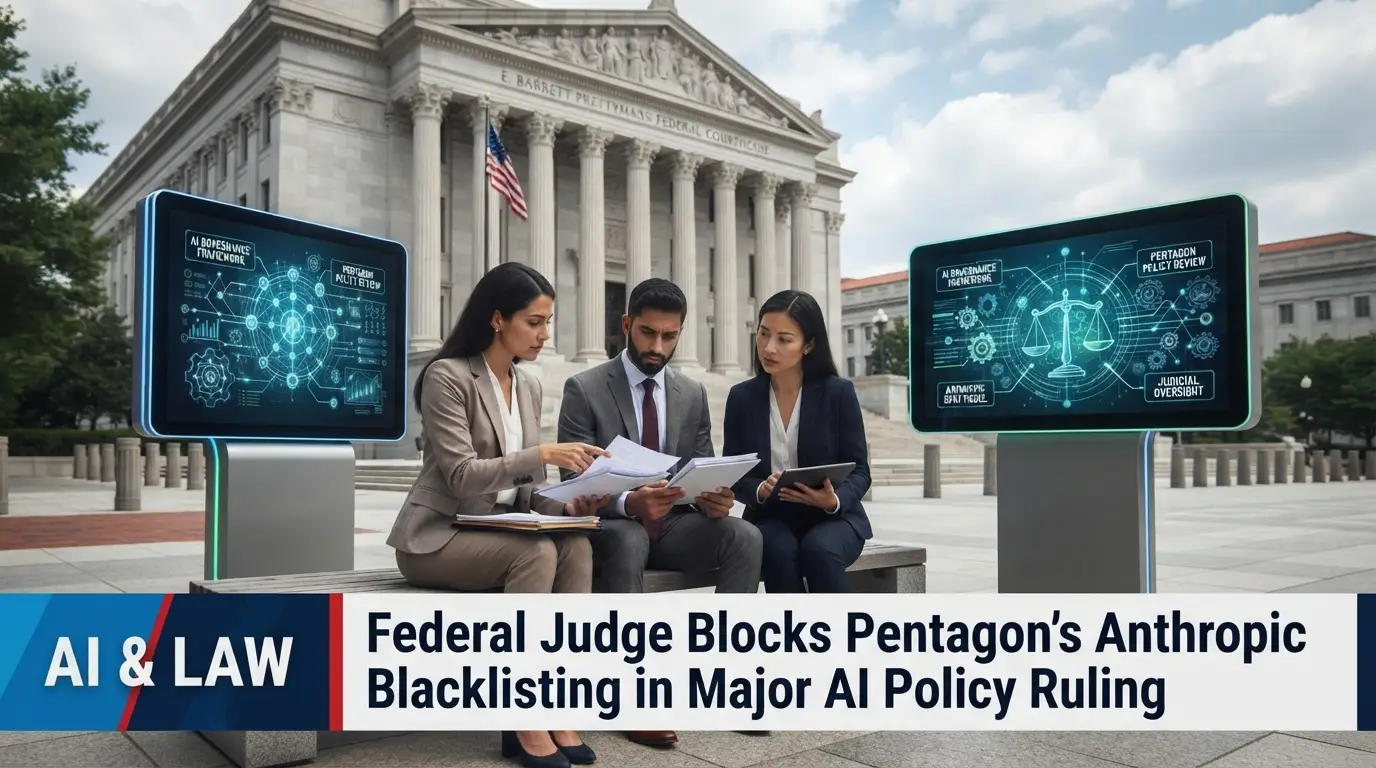


WASHINGTON — A federal judge has blocked the Pentagon from designating Anthropic as a national-security supply-chain risk, delivering a major legal victory to the artificial-intelligence company and creating a potentially important precedent for the relationship between AI developers and the U.S. government.
The dispute began after Anthropic resisted allowing its AI systems to be used for autonomous weapons and domestic surveillance. The Pentagon subsequently moved against the company, but the court found the government's action unlawful and without sufficient basis.
A New Boundary for Government Use of AI
The case highlights a growing conflict over how advanced AI should be used by the U.S. military.
Government agencies increasingly want access to sophisticated AI systems for intelligence, logistics and national-security applications.
AI companies, however, are establishing their own restrictions on certain uses.
Anthropic has argued that its safeguards are intended to prevent its technology from being used for autonomous weapons or domestic mass surveillance.
The Pentagon took a different position.
The resulting dispute eventually moved into federal court.
The judge's ruling is significant because it raises questions about whether the government can penalize a technology company for refusing particular uses of its products.
The case could influence future negotiations between AI companies and federal agencies.
Other AI developers are likely to watch the outcome closely.
The United States is simultaneously trying to expand its AI capabilities for national security while encouraging private companies to develop increasingly powerful systems.
That creates an unusual relationship between Washington and Silicon Valley.
The government needs access to advanced technology.
Technology companies want to participate in government contracts but may also want control over how their systems are deployed.
The Anthropic case demonstrates how complicated that relationship can become.
For the American AI industry, the ruling could become an important reference point as policymakers determine how much control private developers should retain over advanced AI.