


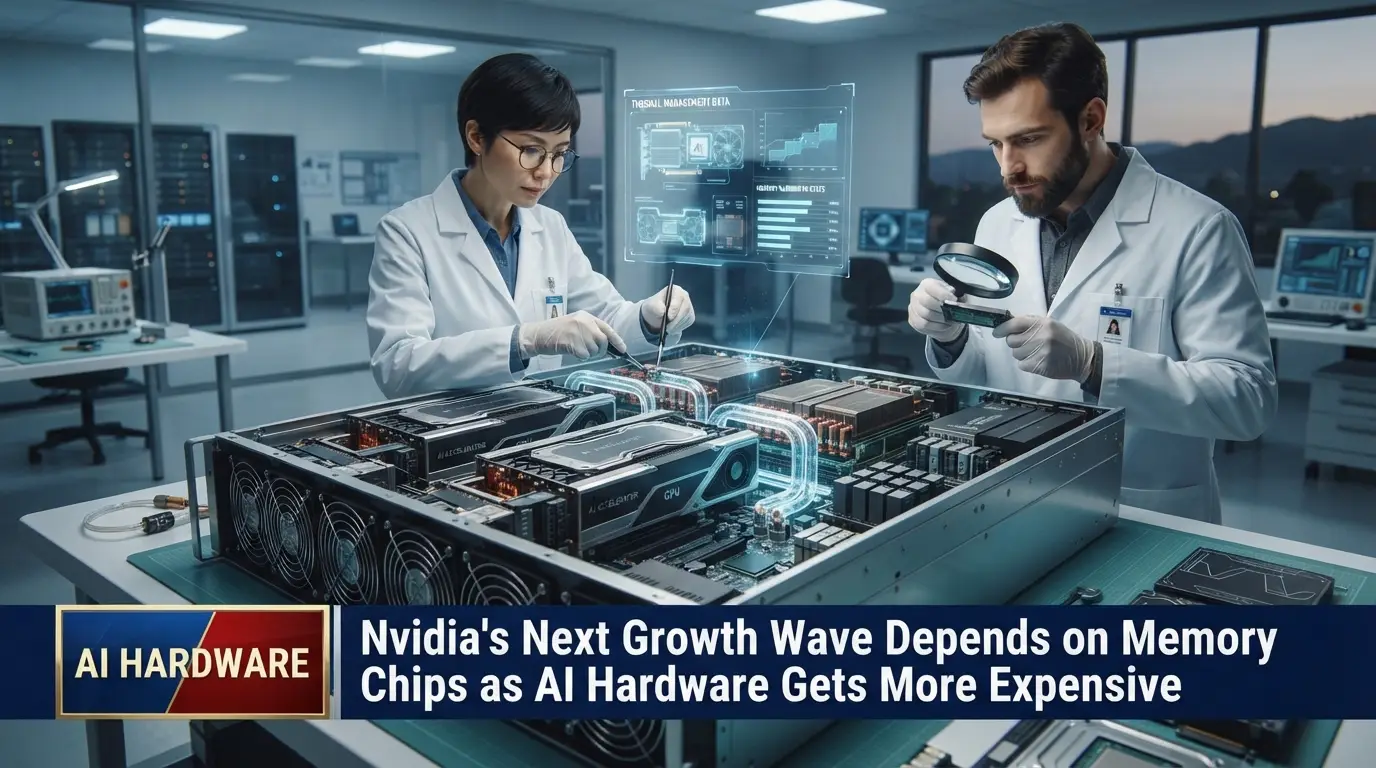


SAN JOSE, CALIFORNIA — Nvidia's latest financial outlook suggests that demand for artificial-intelligence computing remains extraordinarily strong, but the company is entering a new phase in which the availability and cost of memory components could become just as important as processor design.
Nvidia expects major revenue growth to continue into its next fiscal year.
The Hidden Bottleneck Inside AI Servers
The public image of AI computing often centers on GPUs.
But modern AI systems require much more than processors.
High-bandwidth memory, networking components, cooling systems and advanced packaging are all critical.
As AI models become larger, the amount of memory required to operate them also increases.
That has created pressure throughout the semiconductor supply chain.
Nvidia has warned that component shortages and higher costs could affect margins even while demand remains strong.
The company has also expanded relationships with major cloud providers as they build enormous fleets of AI accelerators.
The spending creates opportunities for memory manufacturers and semiconductor equipment companies.
It also creates risks.
If component suppliers cannot expand quickly enough, expensive processors could sit idle while customers wait for complete systems.
That would slow the deployment of new AI capacity.
Nvidia's growth therefore increasingly depends on coordination across the entire semiconductor ecosystem.
The company is forecasting significant future sales, suggesting that management believes the current AI investment cycle has years to run.
Investors, however, are watching whether hardware demand can continue accelerating without causing supply constraints or excessive capital spending.
The next stage of the AI hardware boom may not be determined by who designs the fastest processor.
It may be determined by who can build complete computing systems at the required scale.