


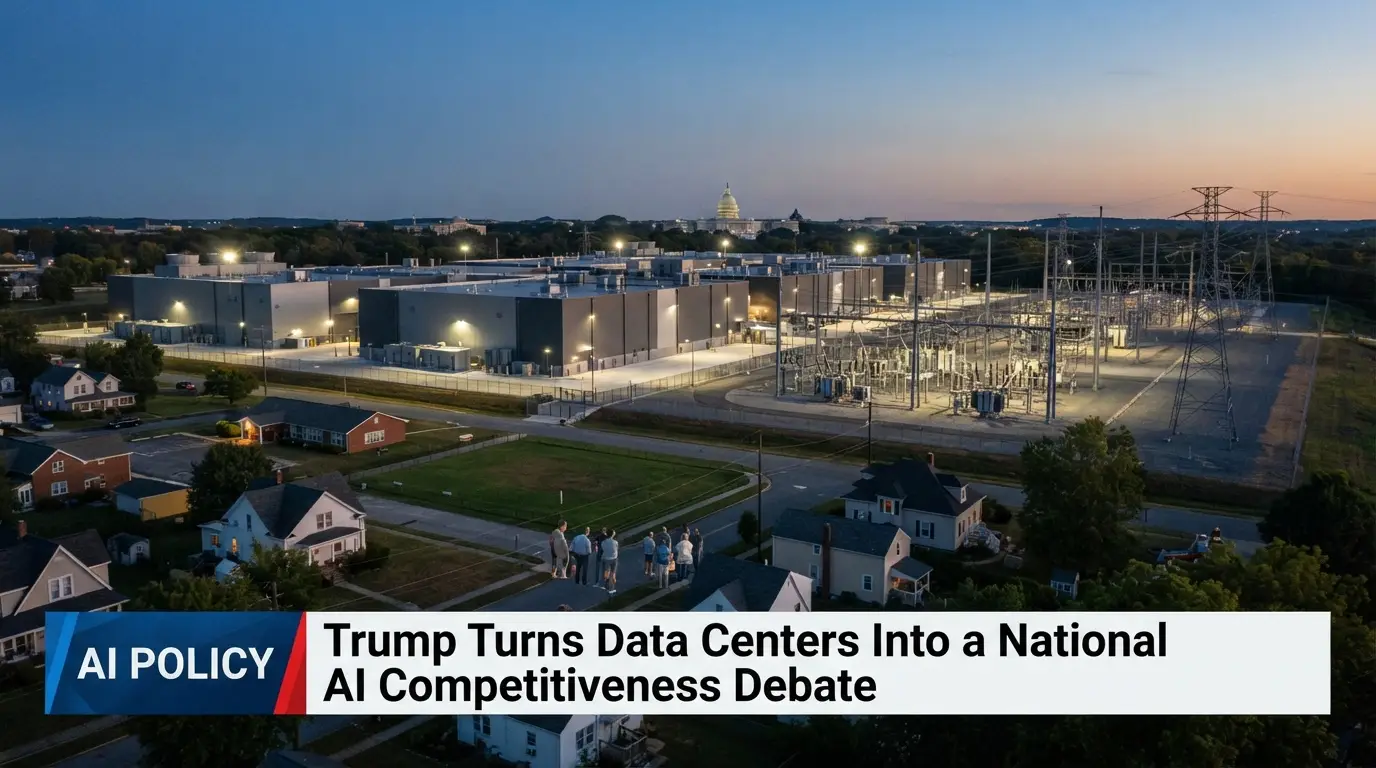


WASHINGTON — President Donald Trump has entered the growing political fight over America's data-center expansion, arguing that communities opposing new facilities risk weakening the United States in its competition with China over artificial intelligence.
Trump's comments come as opposition to large data centers grows in parts of the country because of concerns about electricity demand, water use, noise and local costs.
AI Infrastructure Becomes a Political Issue
Data centers were once primarily viewed as technology infrastructure.
That is changing rapidly.
The growth of AI has turned them into major economic and political projects.
Large facilities can generate construction activity and tax revenue.
But they can also consume enormous amounts of electricity.
That has created tension between technology companies seeking rapid expansion and communities worried about infrastructure costs.
The debate is becoming particularly important in states that are attracting major AI investments.
Local residents are asking whether the economic benefits justify increased demand on power grids.
Utilities are also examining whether customers will ultimately bear some of the cost of new generation and transmission infrastructure.
Trump has framed the issue as part of America's technological competition with China.
His argument is that slowing AI infrastructure could weaken the country's position in a strategic industry.
Critics counter that rapid expansion without sufficient planning could create higher costs for American households.
The debate is likely to continue through the U.S. political cycle.
For the technology industry, the outcome could directly affect where new AI facilities are built.
For American consumers, the issue could eventually influence electricity prices and local development decisions.
The data-center debate has therefore become much larger than a technology-industry dispute.