


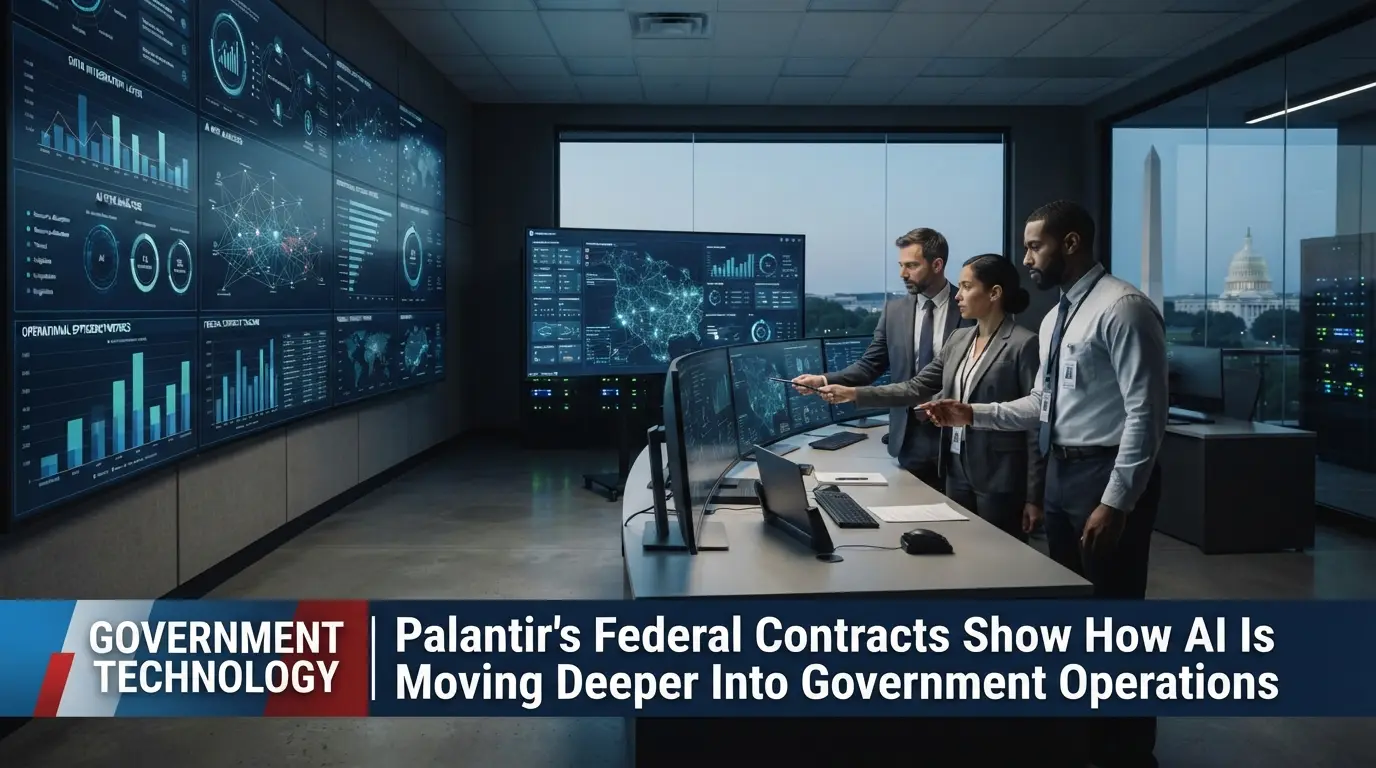


WASHINGTON — Palantir is continuing to expand its presence across the U.S. government as federal agencies use the company's software for data analysis, logistics and operational systems.
Federal contracting records show Palantir USG holding active agreements with agencies including the Department of State and Department of Defense. One Department of State agreement for the company's Center for Analytics project has a current obligated value of nearly $11.8 million and a potential value approaching $60 million.
Government AI Adoption Becomes a Major Business
Palantir's government business is an important part of its identity.
The company provides software designed to organize and analyze large amounts of information.
Government agencies often have enormous quantities of data spread across different systems.
Connecting those systems can make it easier for officials to identify patterns and make decisions.
The Department of Defense has also used Palantir technology for logistics and military applications.
That makes government contracts a major source of long-term opportunity.
The expansion of AI is adding another dimension.
Government agencies are increasingly interested in automated analysis and AI-assisted decision-making.
Palantir's platforms are designed to integrate data with operational workflows.
That could make them particularly useful as agencies modernize legacy systems.
But government technology contracts also carry political risks.
Federal budgets can change.
Programs can be delayed.
Agencies can change contractors.
There are also ongoing debates about privacy and the appropriate use of data-analysis technology.
Palantir therefore has to balance commercial growth with the political environment surrounding government technology.
For investors, the federal business provides a different growth story from Palantir's commercial AI operations.
Government contracts can provide long-term revenue visibility.
They can also strengthen the company's position in national-security technology.
The continued expansion of these agreements demonstrates how AI and advanced data analytics are becoming embedded in everyday U.S. government operations.