

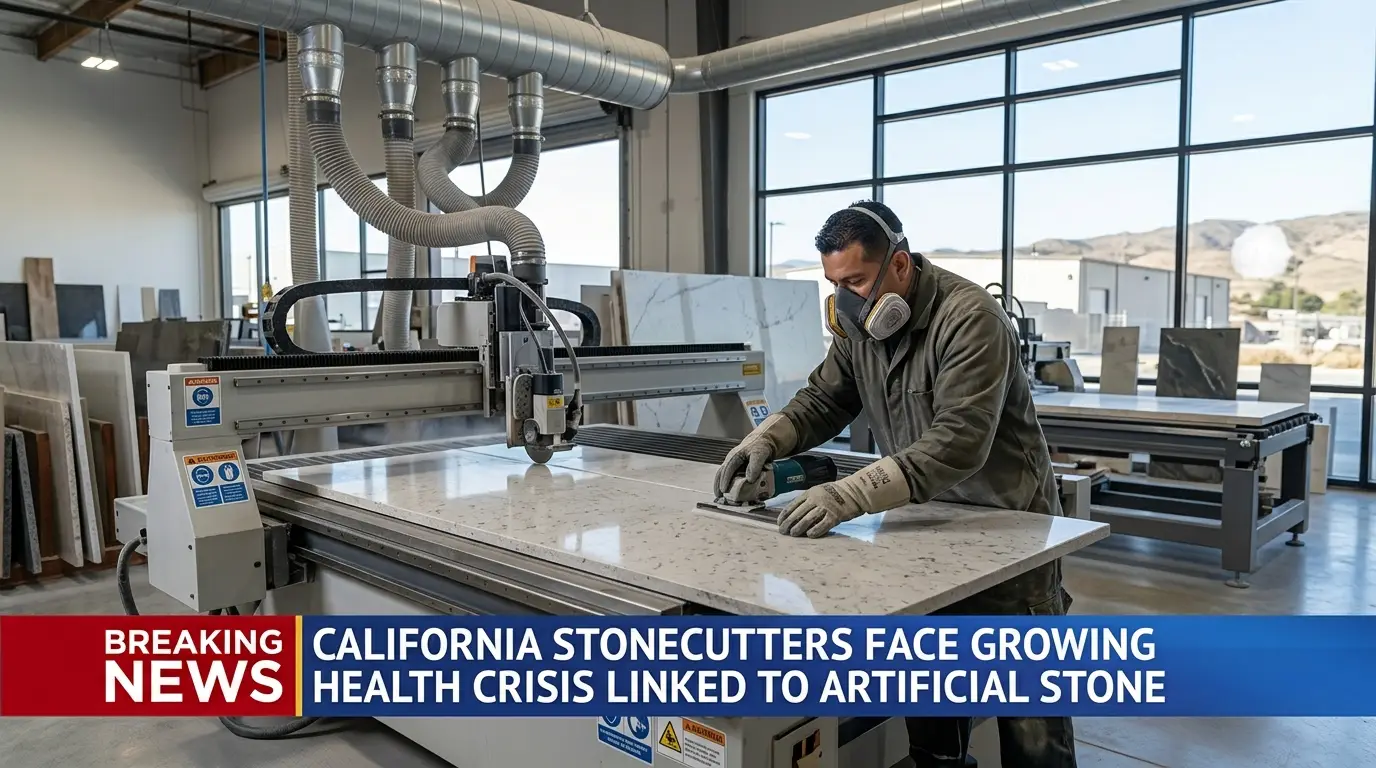


LOS ANGELES — California workers who cut artificial-stone countertops are facing a serious occupational-health crisis, with hundreds diagnosed with silicosis, an incurable lung disease linked to exposure to silica dust.
A recent study found that more than 600 California stonecutters have been diagnosed with the disease, highlighting growing concerns about workplace protections in the countertop industry.
Silica Dust Raises Workplace Safety Questions
Artificial stone can contain extremely high levels of crystalline silica.
When workers cut or grind the material without adequate controls, microscopic particles can become airborne.
Repeated exposure can damage the lungs.
The resulting disease, silicosis, can permanently impair breathing and can ultimately become fatal.
California has already taken steps to address silica exposure among countertop workers.
But the growing number of cases suggests that enforcement and workplace protections remain important.
Many affected workers are employed by smaller fabrication businesses.
That can make consistent safety practices more difficult.
Protective equipment, ventilation and dust-control systems can significantly reduce exposure.
However, workers need proper training and employers must implement safety measures consistently.
The issue has become particularly important in California because the state has a large construction and home-remodeling industry.
Artificial-stone countertops have become popular among homeowners because of their appearance and durability.
The health consequences of manufacturing and installing those products have received far less public attention.
Worker advocates are calling for stronger enforcement and greater awareness.
Medical experts also emphasize that silicosis is preventable through effective exposure controls.
For workers already diagnosed with the disease, however, the damage can be permanent.
The California situation could also influence broader national discussions about artificial stone and occupational safety.
As construction continues across the state, regulators face pressure to ensure that workers are not paying a hidden health price for popular building materials.