

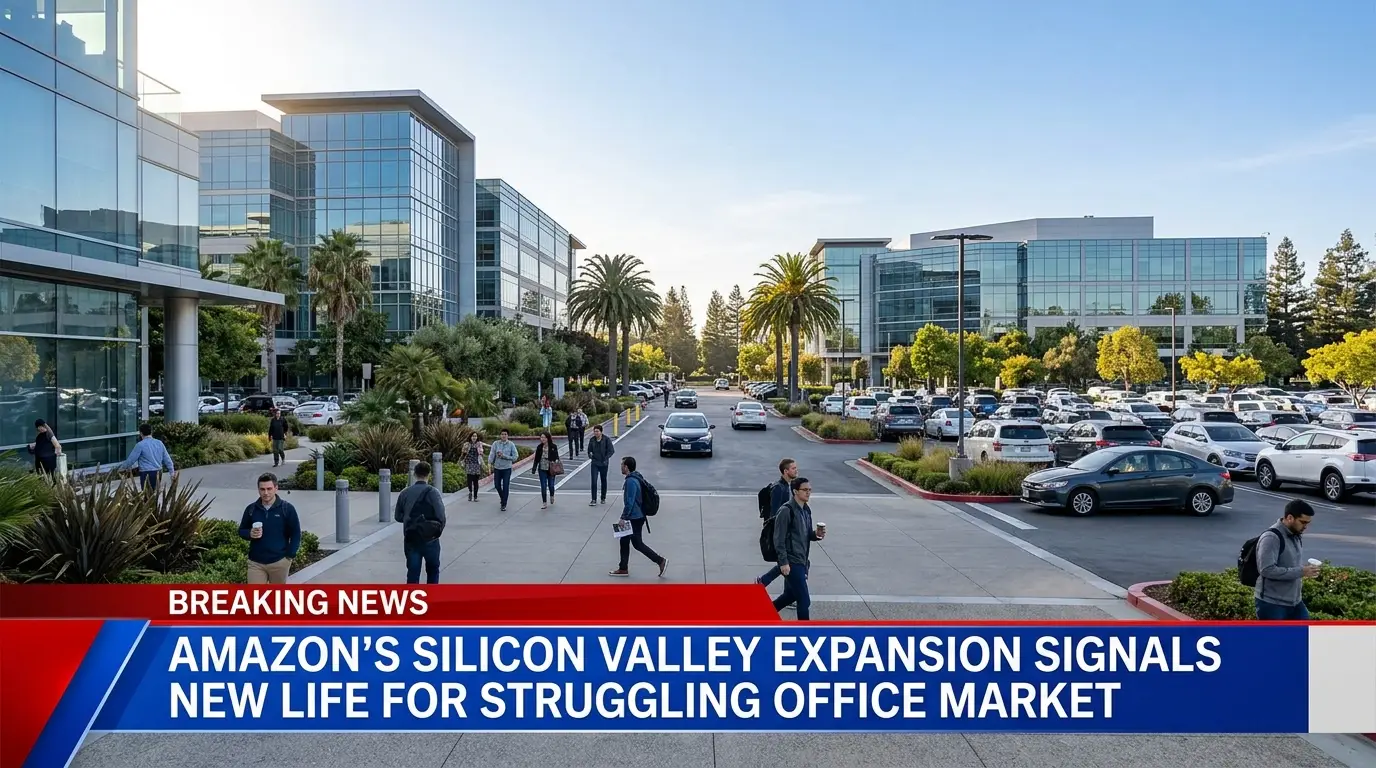


SUNNYVALE — Silicon Valley's battered office market is showing signs of recovery as major technology companies begin taking over existing office space instead of waiting for new construction.
Amazon's decision to move into a Sunnyvale building previously occupied by Google has become one of the clearest examples of companies reshuffling their Bay Area footprints.
Big Technology Companies Reshape the Market
Silicon Valley's office market suffered significant losses after the pandemic as remote and hybrid work became widespread.
Many companies reduced their office footprints, leaving large buildings vacant.
The latest activity suggests that demand is returning in certain parts of the region.
However, the recovery looks different from the office boom of previous decades.
Companies are often moving into existing buildings rather than commissioning large new developments.
That means landlords with well-located, modern properties could benefit first.
Sunnyvale remains attractive because of its location near major technology companies and research centers.
The city also provides access to transportation routes connecting San Jose, Mountain View and other parts of Silicon Valley.
Office activity has broader economic consequences.
Workers returning to offices can increase demand at restaurants, coffee shops, retail stores and other businesses.
A stronger office market can therefore have an impact beyond commercial real estate.
At the same time, companies continue evaluating how much physical space they actually need.
Hybrid work means that many employers no longer require traditional office layouts.
Instead, businesses may prioritize collaboration areas, meeting spaces and specialized facilities.
That could limit the amount of office space absorbed by the market.
Investors are watching the latest leasing activity carefully.
If more large technology companies begin taking vacant space, it could provide greater confidence in Silicon Valley's commercial property sector.
For now, the Amazon-Google office transition is being viewed as another sign that the region's technology economy continues to evolve.