

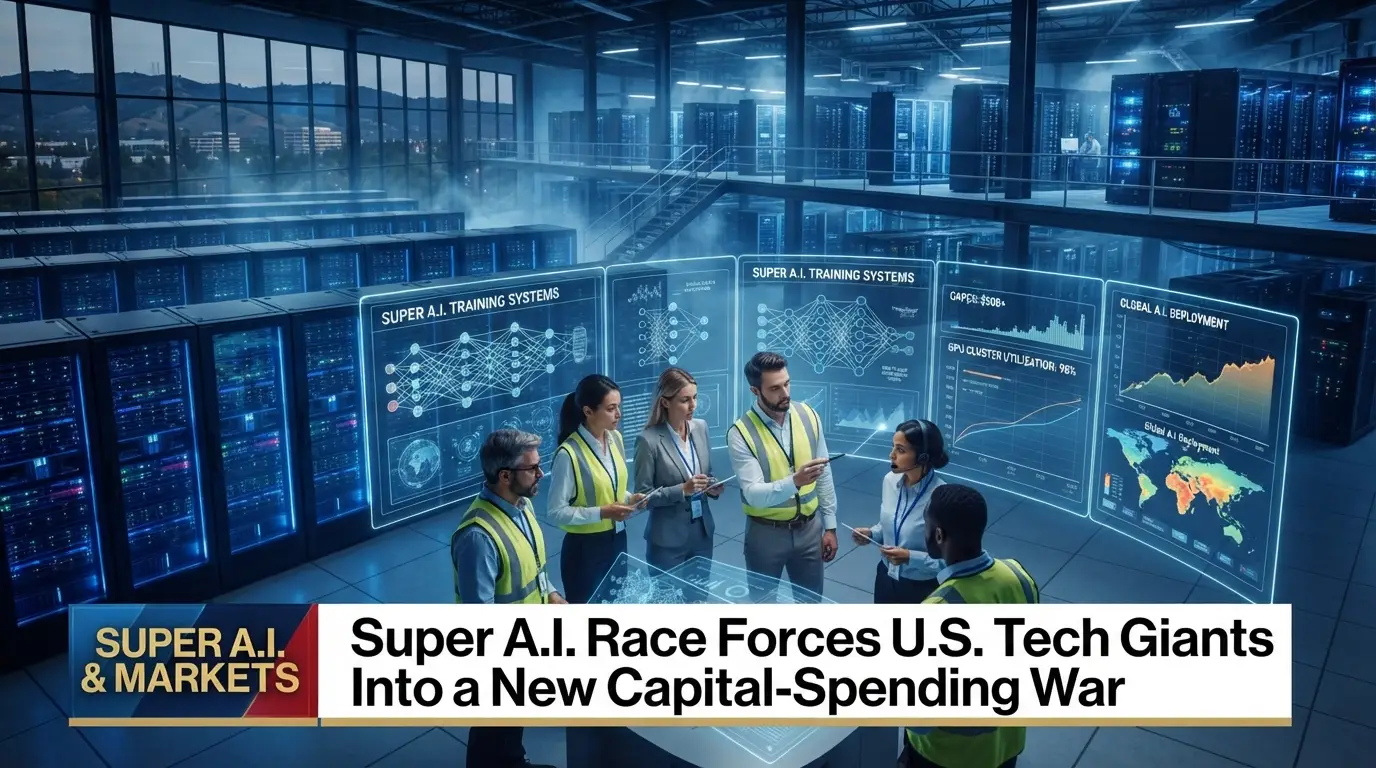


SAN FRANCISCO — The race to build super artificial intelligence is pushing America’s largest technology companies into an unprecedented spending contest involving data centers, advanced chips, energy infrastructure and specialized research teams.
The Magnificent 7 companies are increasingly treating A.I. development as a long-term strategic competition rather than a short-term software trend.
The Cost of Building Super A.I.
Super A.I. systems would be designed to perform complex reasoning, scientific research, coding, planning and decision-making across multiple fields.
Developing such systems requires enormous computing capacity.
Technology companies are therefore committing billions of dollars to new data centers and high-performance processors.
The spending is creating opportunities for chipmakers, cloud providers, power companies and data-center operators.
It is also raising concerns among investors.
Markets have rewarded companies that demonstrate strong A.I. growth, but investors are beginning to ask whether future revenue will justify the scale of current spending.
The answer may depend on whether businesses can convert experimental A.I. tools into dependable products.
Advertising, cloud computing, cybersecurity, financial services and industrial automation are among the sectors expected to benefit.
However, the transition could take years.
The super A.I. race is also creating a talent shortage.
Companies are competing for researchers capable of developing advanced models, efficient training systems and reliable safety controls.
That competition has increased compensation costs and encouraged acquisitions of smaller A.I. firms.
For the Magnificent 7, the stakes are unusually high.
A company that achieves a major breakthrough could gain influence across multiple industries.
A company that falls behind could lose market share, talent and investor confidence.
Stock markets are therefore treating A.I. spending as both an opportunity and a risk.
The next phase of the technology boom will depend on whether super A.I. becomes a profitable commercial platform or remains an expensive research ambition.