


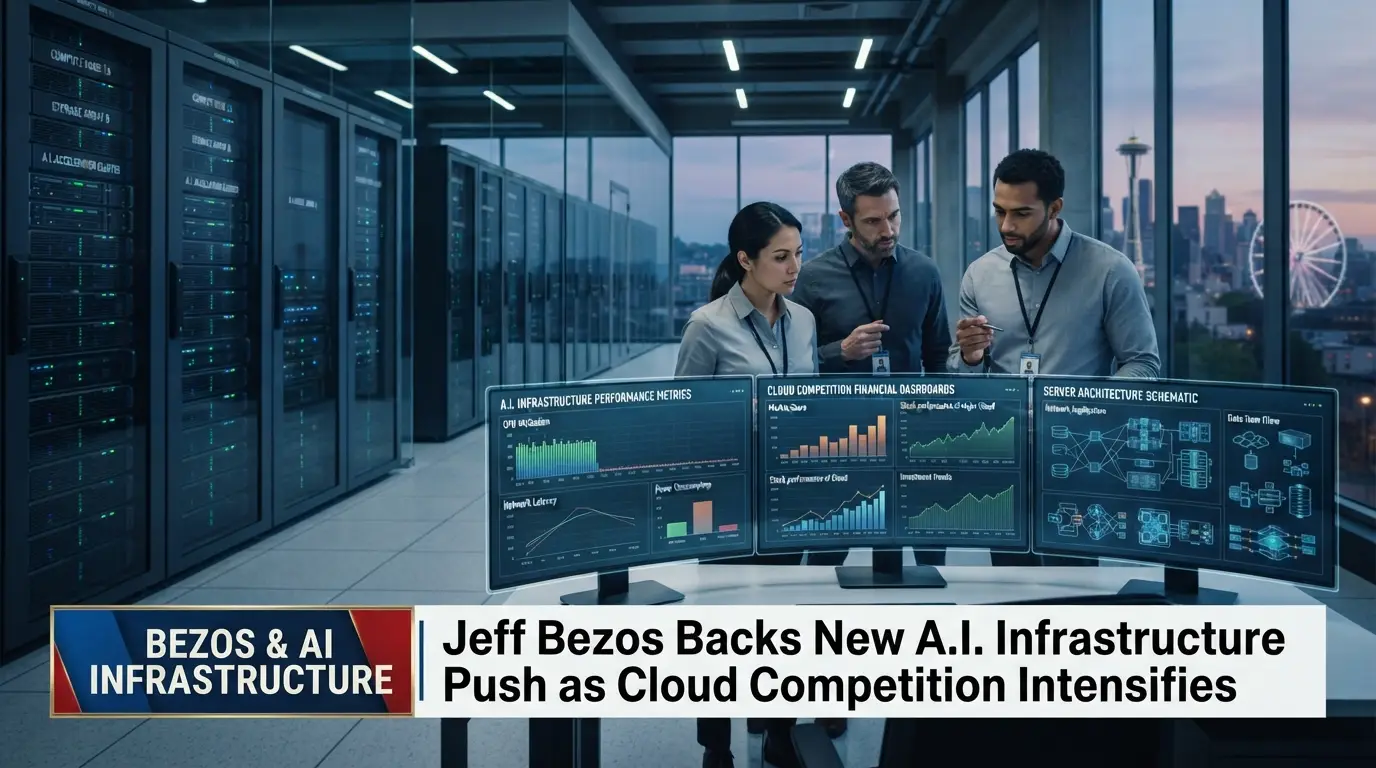


SEATTLE — Jeff Bezos is backing a new wave of artificial-intelligence infrastructure investment as cloud companies compete to provide the computing power required by advanced models.
The effort reflects Bezos’s continuing influence in technology even after stepping away from day-to-day leadership at Amazon.
The Infrastructure Behind the A.I. Boom
A.I. companies require access to powerful processors, high-speed networks and large data centers.
Cloud providers are building these systems so businesses can rent computing capacity instead of purchasing their own hardware.
Bezos has invested in companies developing A.I. software, robotics and cloud-related services.
His involvement has attracted attention because of his experience building Amazon into one of the world’s largest technology platforms.
The current competition is not limited to software.
Companies are also competing for electricity, land, cooling systems and specialized construction capacity.
That has made data-center development a major investment theme.
Financial-technology companies are among the biggest potential customers.
Banks, payment processors and insurance companies are using A.I. for fraud detection, customer service, risk analysis and automated compliance.
However, cloud costs can become significant when models process large volumes of information.
Businesses must therefore determine whether A.I. improves productivity enough to justify infrastructure expenses.
Bezos’s investment strategy appears focused on the long-term expansion of digital services.
Rather than betting on one consumer application, he is supporting the infrastructure that allows many A.I. companies to operate.
That approach could produce steady returns if demand for computing continues to grow.
It could also face pressure if companies reduce spending or develop more efficient models.
For investors, the central question is whether the A.I. economy will be dominated by a few cloud platforms or distributed among specialized providers.