

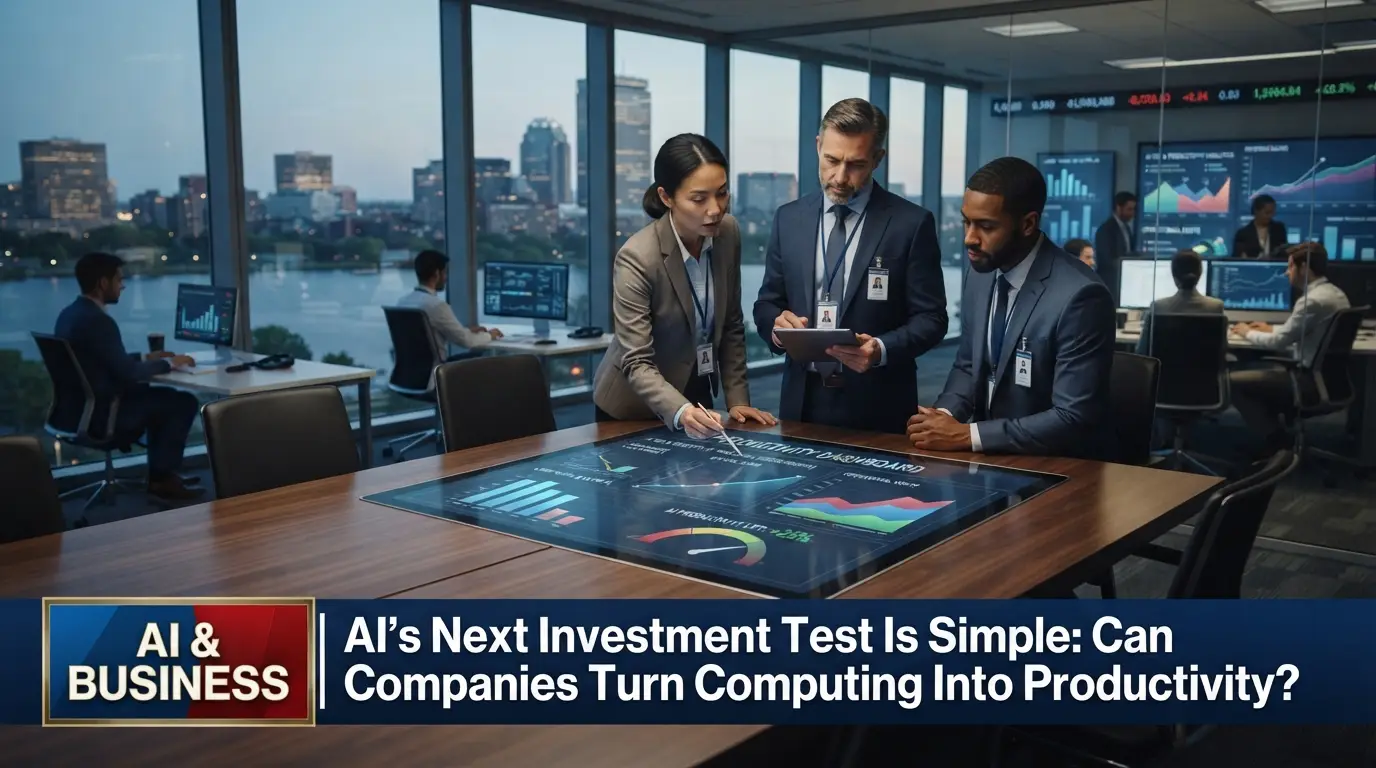


BOSTON — The artificial-intelligence investment boom is entering a new stage as corporate executives face increasing pressure to demonstrate that expensive AI systems are producing measurable improvements in productivity.
For investors, the question is becoming less about how powerful the technology is and more about how much money it can save or generate.
The Return-on-AI Question
Companies across the United States are spending heavily on computing capacity, software and employee training.
The investments are spreading across industries.
Banks are using AI to analyze transactions.
Manufacturers are deploying automated systems.
Retailers are experimenting with predictive inventory tools.
Professional-services firms are using AI to summarize documents and accelerate research.
But experimentation is not the same as financial return.
Executives increasingly need to show that AI projects reduce costs, increase revenue or allow employees to accomplish more work.
That creates a new challenge for technology vendors.
Selling access to an AI model may not be enough.
Customers want measurable outcomes.
This could favor companies that specialize in narrow business applications rather than general-purpose tools.
It may also create pressure on cloud providers and data-center operators.
If customers discover that certain AI workloads provide little economic value, they may reduce computing consumption.
That would challenge the assumption that AI infrastructure demand will grow indefinitely.
The opposite is also possible.
If companies demonstrate major productivity gains, AI spending could accelerate as businesses race to avoid falling behind competitors.
Investors are therefore beginning to watch corporate earnings calls for a different type of information.
Instead of simply asking how many companies are adopting AI, they want evidence of what those systems are actually accomplishing.
The technology boom may continue for years.
But the next phase will increasingly be measured in dollars saved, revenue generated and hours of work eliminated.
That is the point at which AI enthusiasm becomes an economic transformation.